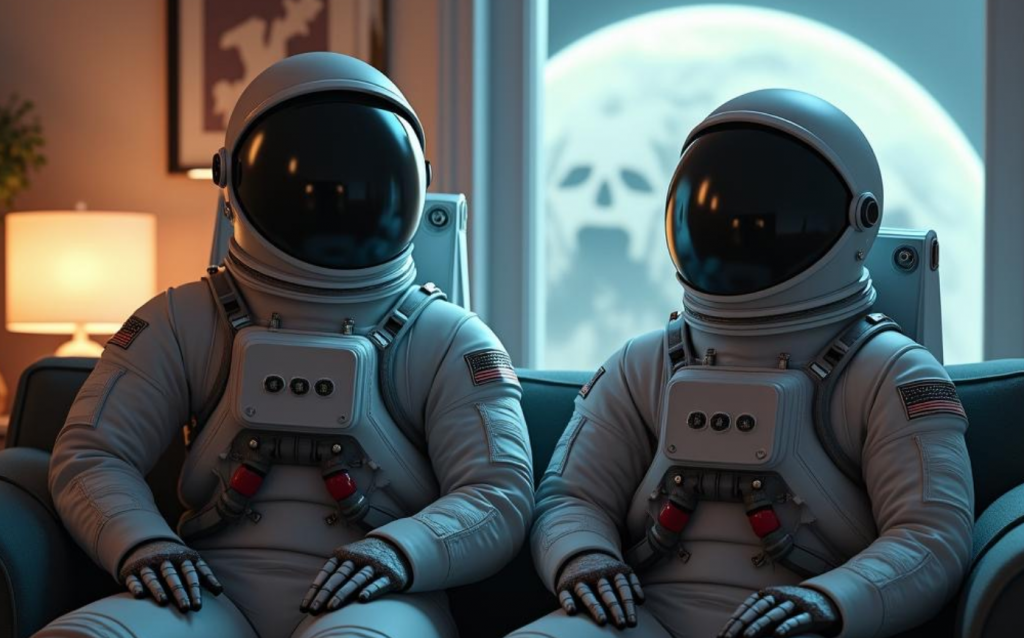
Hailing from, London, the enigmatic musical duo Ghost of Panama—comprising Keith Welham and Cristabel Liu—has crafted a true atmospheric gem with their debut album, The Last Food on Earth. Released on April 27, 2026, this 10-track collection gracefully weaves raw, authentic folk with soft-rock melodies, offering a soundscape that is both deeply cinematic and hauntingly mysterious.
We caught up with the band to unpack their creative process, West London influences, and the art of staying human in a digital world. Dive into our exclusive interview below.
If a complete stranger stumbled upon The Last Food on Earth without knowing anything about Ghost of Panama, what is the one emotion or truth you hope hits them right in the chest within the first sixty seconds?
That’s hard. It depends if they start at the beginning or not – not everyone does these days. I suppose that if they started at the beginning and played “The Lift” then they’d get a feeling of hopelessness and despair. Again, if they played “North Star” then I’d hope that it might be in some way uplifting. Overall, the idea was to take people on a journey. You can start in a bad place but you have choices which could be good or bad. You could go nowhere, stay the same, do something drastic or gentle and then emerge, hopefully, on the other side.
The other aspect to this is that you don’t just arrive somewhere. The journey is important and, although we have a success-oriented society where people are often valued by their achievements, maybe it’s the route they take to get there which is more valuable. Maybe that’s the real message but I am not sure that’s easily distilled in sixty seconds. I reckon I need to up my songwriting skills to achieve that.
You’re blending raw, authentic folk-rock with innovative pop melodies. If you had to describe this sonic cocktail to a classic rock purist, how would you pitch your style?
It’s not easy. We do really consciously try to not sound like anyone. There are clear influences in certain aspects – you can hear a bit of the Cure (c. 17 Seconds) in the guitar, I think. Or, alternatively, I nicked a bit of a Peter Hook vibe in “Island” and “Ghost of Your Perfume”. Careful listeners might even be able to pick a bit of “Arnold Layne” in “North Star”. But, I think it’s fair to say that we sound like none of those. You always have to work to try and keep yourself original. For example, I recall that, when we were working on an early version of “Stockholm Syndrome Reversed”, I woke up one night and realised “Thats ‘Babooshka’ by Kate Bush”. I kept the F/E/Am progression as the song needed it but had to completely rewrite the keyboard part to be less derivative.
The interesting thing is at what point does so-called good technique whether in melody, harmony, lyricism or song structure become a cliche. It’s a really fine line to walk. Popular music trades heavily on familiarity but familiarity breeds contempt. The secret, I guess, is to have enough elements for people to hang on to but to change one of the others to something unexpected.
Your album maps the brutal life-cycle of a relationship, from entrapment to resolution. If this tracklist were a survival guide for a failing couple, at which song should they definitely stop and read the instructions?
Optimists should sit to the end, pessimists or the terribly impatient should bail out early. It’s genuinely a difficult one to answer because although there’s a beginning and an end, the middle is not linear. In fact there are a number of things that are choices but can also be mutually true and interpreted differently later.
Compare that, for example, with something like Pink Floyd’s “The Wall”, where a very privileged rock star gets fed up, wants out, blames his childhood, flirts with fascism and then finds some redemption which is a very linear story.
A lot of the “states” on “Last Food” can co-exist. There’s a clear beginning and scene setting (“The Lift”). This is amplified and morphs into acceptance (“Stockholm Syndrome Reversed” and “Half-Life”) and there’s a clear drawing a line and sense of moving on with “Afterlife”, which is walking out and slamming the door and a resolution with “North Star”. In the middle, though, there is a cocktail of alternatives and ambiguity. This is more realistic about real life. Let’s put it this way, how many of us live our lives with a clear direction and a hard-coded plan. I hate linearity. So, for example, “Ghost of Your Perfume” on its own can have two interpretations and, if one of those interpretations is chosen then “Siberia” can’t happen. Actually, the whole album makes my head hurt the more I think about all the options and alternative meanings. I think it’s the ambiguity and openness for interpretation that make it work compared with dragging the listener down some increasingly forced storyline compared with their everyday life.
If you could send a 30-second voice note back in time to the 2022 version of Ghost of Panama, what’s the ultimate piece of advice you’d give yourselves to survive the journey to this album?
The flippant answer is simply not to start. It’s been really hard and there are so many things that come back and bite you. The emotional excavation was an exercise in itself without all the effort in putting all the parts back together again.
I think what I learned from this project is to aim high and to stay true to your “North Star”. In the end you may end up in a good place but the road towards it is not necessarily easy or straightforward. Nothing of value is given for nothing.
The other thing is to keep going. There were times when I thought that I couldn’t go on and finish it. This thing was taking over my life. And for what purpose? It’s not going to make us rich or famous. Yet, there is a real genuine satisfaction in pulling together something that defies convention. It’s been called a concept album although I’d prefer to call it “thematic”. Also, and these are the unsung heroes, our families who cut us the space to do this and, in my case, overlooked where I was letting things drop elsewhere.
“North Star” delivers a massive wave of optimism after nine tracks of “unrelenting bleakness.” Do you think humans need to stare into the absolute dark before they can actually appreciate the light?
I think I had to. Also, you need also to be able to step back and be able to rationalise. I doubt if would have been able to write well about some of those events in the immediate aftermath.
Of course, you can only write from experience. You don’t have to experience 100% of those things you write about, but you do need an understanding, an empathy and an ability to rationalise. Clearly, though, the closer you get to the real thing then the more authentic you will sound and people will pick up on this.
“Siberia” is a massive, sweeping landscape, while “Damage” feels like an accessible pop song. Is it harder to write a track that feels like a huge movie scenery, or a direct, catchy tune?
Siberia was easy to write as it was based on an event years ago. I ran into an ex-girlfriend one snowy January outside the library in North Street in Guildford. We just looked through eachother even though I recognised her and she perhaps recognised me. The distance beteeen us was palpable. The secret is to somehow file these things away in your head so you can recall the feeling on demand. The distance and the snow led me straight to Siberia and the song almost wrote itself plus the big hook “there’s a big, big gap between me and you”. Of course, the trick was to make it richer with howling winds, Slav choirs and Russian dialogue plus a few clicks, bangs and pops we shoved in for a laugh. In some ways, it’s the song I am most proud of on the album.
Damage was harder to write. I was trying to walk a thin line between someone explaining their bad actions without giving them a platform to glorify or justify themselves. It’s actually a harder song lyrically than people sometimes realise. It’s all about people being aware that they are being abusive and not changing. The idea behind the second verse was to spit as many excuses out as possible but without using verbs to indicate that the person had no concept of action or guilt at all. With all that I had to soften it a bit with the music. It’s also the song that gives the album its title as the protagonists actually start to emotionally consume eachother.
So, there’s a trade off. It’s a matter of what way do you want to make a point. You can hit hard with the lyrics and then soften it with the tune. Alternatively, there’s the approach where everything hangs together in an immersive soundscape.
I’m not sure that one is intrinsically harder than the other but you need to balance how you use the tools. There’s two ways to win an argument or to persuade people about something. The first is to bring them along with you on and get your point across through some sort of osmosis / that’s the “Siberia” way. The alternative is to hit them with something punchy which gives a more immediate impact as in “Damage”
I tend to prefer the former but the latter approach can work as well.
Critics praised you for achieving total thematic cohesion without being pretentious. In the indie-rock world, how hard is it to write a deep concept album without accidentally becoming “that snobby art band”?
We certainly don’t want to sound or be pretentious. I think I’d prefer to refer to the album as “thematic” rather than as a “concept” album which, to me at least, seems to suggest forcing a particular and often not easily relatable narrative on the listener. The material on “Last Food on Earth” covers something that most people, even if they had not fully experienced it, would at least have some empathy with. It’s not written as some abstract concept handing down wisdom from on high but from experiences that a lot of people can relate to.
I realise also that we’ve painted ourselves into a bit of a corner. Looking back, it was a brave move to do something so ambitious for a debut album but it felt like the right thing to do. Of course, it makes the dreaded second album an even greater challenge.
We can’t just slap out a bunch of songs on the next album as that would look like either a retreat from what we’ve achieved here or that we were short of songs that hung together.
Fortunately, we have absolutely no shortage of songs and I intend the next album to be “thematic” in some form. Hopefully, it won’t be as emotionally draining as this one.
West London is practically a third member of the band given how much city noise is woven into the tracks. If London could talk back after hearing the album, what do you think it would complain about?
Probably, that we didn’t pay it royalties for the noises we mixed in with the drums or the various ambiances we flew in. At one point we were running around with our phones recording everything. A lot of it got dumped as things didn’t quite fit but we used it as inspiration for some of the things we did put in. There’s a lot of subtle things in there but most people will think we just messed things up.
Your instruments sound incredibly organic, sincere, and beautifully played. In an era increasingly dominated by AI and flawless digital loops, is playing music with real flaws and human hands a form of rebellion for you?
That’s very flattering but we can’t claim virtuosity on any of the instruments. We try and play where possible but we are not averse to using virtual instruments or synths when they make sense. For example, on “The Ultimate Maybe” the only sound I wanted was a cor anglais but there’s no way that I was going to go off and learn a double reed instrument just for that. Similarly, the ronroco sound on “Ghost of Your Perfume”. It’s more about doing what works rather than setting iron rules.
I think it helps that I write either on guitar and piano and not by slapping something over a drum loop. When you do that and come to program some drums or something, you realise that some things you have weren’t as simple as you thought. For example, there’s sometimes an odd bar of 3/4 in a 4/4 song and you’ll never get that jamming over a drum loop unless you consciously premeditate it. On “Last Food on Earth”, if you listen to “Half-Life” and “Afterlife” which are more-or-less the same song approached differently, you’ll hear that there’s one bar which goes into 5/4 every so often and plays the last two beats as triplets. We do sometimes use different time signatures to throw things a little off kilter.
The other thing is to get the drums and vocals to line up. Listen to a good jazz drummer playing behind a good sax player playing a solo and you’ll hear how one drives the other. At the very least, though, just try and avoid the quantise function where possible and that gets you quite some way to a natural feel.
What is the very first thing you both did the moment the final master was approved—celebrate, or sleep for three days straight?
It was a sort of numb feeling. I couldn’t believe that we’d finished it. I had lived with this since late summer 2025 until April 2026. It had begun to take over my life as I was slotting in work on it in any moment where there wasn’t anything else happening.
We made a conscious effort not to do any publicity right away. It was still a very raw experience and I don’t think I’d have been able then to do a good interview at that point.
The problem was that we couldn’t just flick a switch and stop. We tried to slow down gradually. So, we decided to do a couple of cover versions – “Subterranean Homesick Blues” and “Paris 1919” which were a lot less intense.
After we had done those we were able to relax and even switch off a bit which is just as well. The studio is on the top floor of the house and, with the heatwave taking over the country, it would be brutal working up there.
So, we are now taking a few weeks off before we start work on the next single.
You may also like
-
Barry K Wilson Unleashes absolute Magic (and All the Feels) with “Don’t Leave”!
-
Lauren Akosia Reveals New Single “It’s Time”
-
Bobby Freemont’s Debut Is an Exquisite Portrait of Grief, Growth, and Grace
-
Noah Villeneuve Reveals Debut Album ‘Songs of Noah Villeneuve’
-
Finding Freedom in the Pause: Lucy Robinson’s Let Down