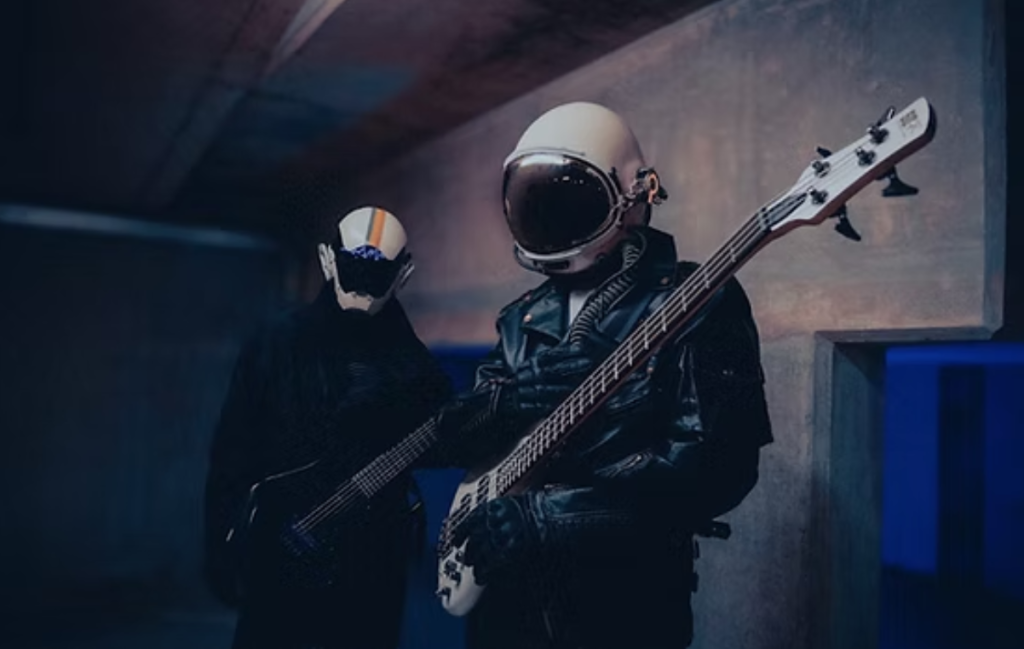
Max Macready’s “The Hunt” feels like a transmission recovered from a future that never quite arrived. The UK duo takes darkwave, synthwave, electronic music and post-punk and places them inside a cinematic science fiction landscape populated by analogue machinery, neon-lit spaceports and distant signals searching for someone willing to answer. Yet beneath the retro-futurist imagery is a surprisingly human subject. “The Hunt” is about pursuit, attraction and the uncertainty of whether the connection being chased actually exists. There is something deliberately elusive about the song, as though its characters are constantly moving toward something that remains just beyond their reach. The result is a track that feels both nostalgic and forward-looking, borrowing the visual and sonic language of an imagined technological past to explore very contemporary anxieties.
The song’s central idea is the instability of communication. Max Macready asks whether a perceived connection is genuine or simply an invitation that one person has imagined into existence. That uncertainty gives “The Hunt” its emotional tension. The chase can be thrilling, but it can also become a pattern in which we knowingly repeat experiences we understand may not end well. The song reflects on time invested, crossing worlds and starting over, while suggesting that modern communication has made it easier than ever to confuse signals with intimacy. Beneath the science fiction concept is an observation about contemporary life, where technology constantly promises connection while creating new opportunities for manipulation, misunderstanding and control. The hunt, in this sense, is not simply romantic. It is psychological and cultural.
Musically, the duo create an impressive collision of influences. Gary Numan, Nine Inch Nails, Jean-Michel Jarre and Vangelis can be felt in the electronic atmosphere, while John Carpenter’s cinematic instincts provide a darker sense of space. The progressive ambition associated with Yes and Rush adds another dimension, while The Police contribute to the rhythmic drive. Max Macready handles bass, synthesizers and composition, creating the electronic framework, while Kurt Precinct brings guitars, textures and vocals that give the track its more physical edge. The fact that the composition and arrangement remained largely intact through the recording process gives “The Hunt” a sense of immediacy. Even the circumstances of the vocal recording, captured around 3am in London before the outside world became too noisy, seem fitting for a song that feels most at home between worlds.
The accompanying video expands that universe rather than simply illustrating the song. Moving away from the fuzzy transmission concept of “Holding Pattern,” Max Macready creates a tangible world in which the characters physically travel through strange landscapes and obsolete technological environments. Cornwall, Goonhilly Earthstation, Gwithian Beach and the derelict RAE Bedford air tunnel control room become the foundations for a world that feels convincingly futuristic without abandoning its analogue roots. The decision to rely heavily on real locations, practical details and restrained visual effects gives the project a tactile quality that suits the music beautifully. “The Hunt” ultimately feels like more than a single. It is another fragment of Max Macready’s fictional universe, a signal that has finally crossed the void and is waiting to discover whether anything on the other side is listening.
You may also like
-
Album Review: Nathaniel Sutton’s The Days – A Warm, Poetic Journey Through Indie Soundscapes
-
From Dancefloor Hits to Late-Night Vibes: Unlocking Nada UV’s Peach Pyramid
-
Slowlight’s Sabo Vano Is the Ultimate Sonic Detox
-
Like a Friend Singing to Your Soul: Discovering Jon-Olov Woxlin
-
Today’s Music Discovery: “Put My Trust in Jah” by INTI AYVAR WALTZ