
“Did you pay your rent? / Did you book another dinner? / Did you fantasize?” Heard closely, these are the questions people trade every week without noticing they are questions at all. Sophierce sets them down one after another, and from far enough away they begin to sound like an inventory, a record taken by someone trying to work out what this species does with its days. Then comes the answer, a single word left to stand on its own: “Realize”. It isn’t a reply to any of them so much as a reply to the fact of them.
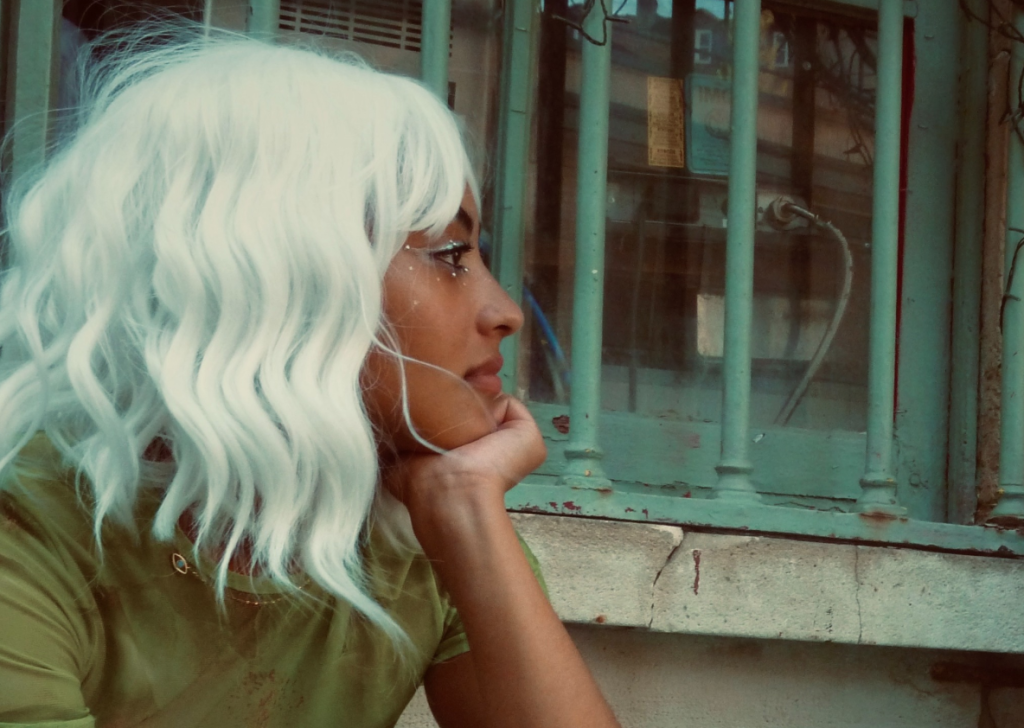
That distance is the whole method of “Senescence”, a single that came out on 25 September 2026 and is out now. The song looks at human life through an observer of human behaviour, an otherworldly being who seems to be watching us almost for the first time. Sophierce traces the song back to masks “tied not only to personality, but to material things, status and the image they created”, and she puts the reason for that vantage point plainly: “Sometimes you need that distance to recognize what is actually meaningful and what is only important because we’ve all agreed to treat it that way.” I keep returning to that last clause. It doesn’t say these things are worthless. It says they are agreed upon, which is a different and far more interesting thing to notice.
So the being keeps looking. In the next verse the observation sharpens into something closer to a diagnosis: “Credit cards save avoidance / Avoidance saves the big man”. I love how the line is built, each half handing its weight to the next, so that a small private habit of putting things off turns out to be holding up something much larger than the person doing it. An outsider would simply see the chain and follow it to its end, and that is what the lyric does. Then a turn I didn’t expect: “Excited to be learning / But lessons can be poison”. Curiosity itself is under examination now, the suspicion that not everything we are taught deserves to be kept.
The poison returns at once, and with it one of the most quietly pointed images on the single. “Creator of the poison / Doesn’t use his own supply”. It reads like something the being has noted with mild astonishment, the kind of detail a stranger spots precisely because nobody nearby thinks to mention it. Whoever makes the thing knows better than to take it. Then the verse widens out to something kinder: “At least nature makes the antidote / That blooms nearby”. The observer isn’t only cataloguing what is wrong. Close at hand, growing without anyone’s agreement, there is something else, and the line lets that sit beside the critique rather than in place of it.
Language comes in for the same scrutiny. “Words shaping the truth / Why say that you’re dying? / When you want something / You want to be alive”. This is the verse where the observer turns from what we buy and borrow to how we speak, and it catches one of our odder habits, the way we reach for the vocabulary of death to describe wanting. Dying for a holiday, dying to see someone. To an ear from elsewhere it must sound alarming. The correction the song offers is gentle and exact: what you mean is that you want to be alive.
And that correction becomes the song’s hinge. Having spent its opening verses watching, “Senescence” finally speaks in the first person, and what it says is the plainest thing on the single: “I i i want to live / I i want to survive / I want to live live live / In this life”. The stammer in that first word is wonderful, the sense of a voice reaching for a declaration it hasn’t quite made before and repeating it until it holds. After all the distance, here is proximity. The observer, or whoever has been borrowing her eyes, arrives somewhere personal and stays there.
Soon after, the lyric names its own title outright: “Dandelion senescence”. It is the image the song grew from, a yellow flower losing one form before it becomes the white seed head that can disperse freely, and it gives the instruction that follows its sense. A run of “Something’s got to give” passes through, and then comes “Let go of the illusion”, said twice and then cut back to “Let go”, as though the being has watched the dandelion and is passing on what she saw. Near the close arrives a line that rewrites everything before it: “This is the first time i’ve been alone”. Set against the crowded opening, with its rent and its dinners and its booked plans, that solitude doesn’t read as loss. It sounds like the clearest the voice has been all song.
You may also like
-
KIER Names Her Peers Around New Single ‘Twenty Something’
-
Lilliane’s Hollywood EP measures the gap between a childhood dream and real life
-
Vizco – “Answer”: Melancholic Afro-Vibes & Soulful Vulnerability
-
OFFICA: Our Artist of the Week & Month’s Top Discovery
-
Junoflo – “Badman”: Aggressive Flow & Pure Mastery