Fate Envoy’s debut album The Tower is an ambitious alternative rock record that turns crisis into a narrative of transformation. Across nine songs and just under 36 minutes, the Hudson Valley band creates a record that feels less like a collection of individual tracks and more like an emotional journey with a clearly defined beginning, descent, rupture and return. The unusual element is the way that journey connects to the Major Arcana of the Tarot. Rather than constructing the songs around a predetermined concept, Eric Anderson and Ari Bayvertyan discovered that material they had already written corresponded remarkably closely with nine Tarot archetypes. That distinction matters because it allows the concept to feel organic rather than imposed. The Tower is not an album pretending to have a story. It is an album that discovered its story within itself.
The opening sequence immediately establishes that sense of movement. “Unforeseen Circumstances,” associated with The Moon, enters a world of uncertainty and disorientation, setting the psychological tone for everything that follows. “Lightning,” connected to The Hanged Man, introduces suspension and altered perspective, while “Sonny’s Party” embodies The Fool through its reckless willingness to leap into experience. “Grandfather” then turns toward ancestry, memory and reckoning through Judgement before the title track becomes the record’s central fracture. “The Tower” represents the collapse of established structures and the painful revelation of what lies underneath them. From there, “War Is Hell” takes on the role of Death, presenting destruction not as an ending in itself but as the necessary removal of something that can no longer survive. The sequencing makes the album feel almost ritualistic, with each song functioning as another stage in an emotional reading.
Musically, Fate Envoy give this concept a suitably volatile foundation. The band moves between nervy indie rock, pop-punk immediacy, atmospheric alternative rock and heavier hard rock, drawing on the guitar drive of The Strokes and Arctic Monkeys while incorporating the expansive textures of Radiohead and the aggression of System of a Down. That variety works because the album itself is about instability. “I Can Barely Talk,” representing The Hermit, withdraws into solitude after the destruction of the preceding tracks, while “A Moment In Eternity,” linked to The Star, opens the record back toward nature, healing and the cosmos. The closing “This Dance,” associated with The Lovers, is particularly important because it reframes connection as a choice rather than a reward. After everything has collapsed, vulnerability becomes an act of courage. The guitars and vocals retain their urgency, but the emotional destination is no longer destruction. It is reconnection.
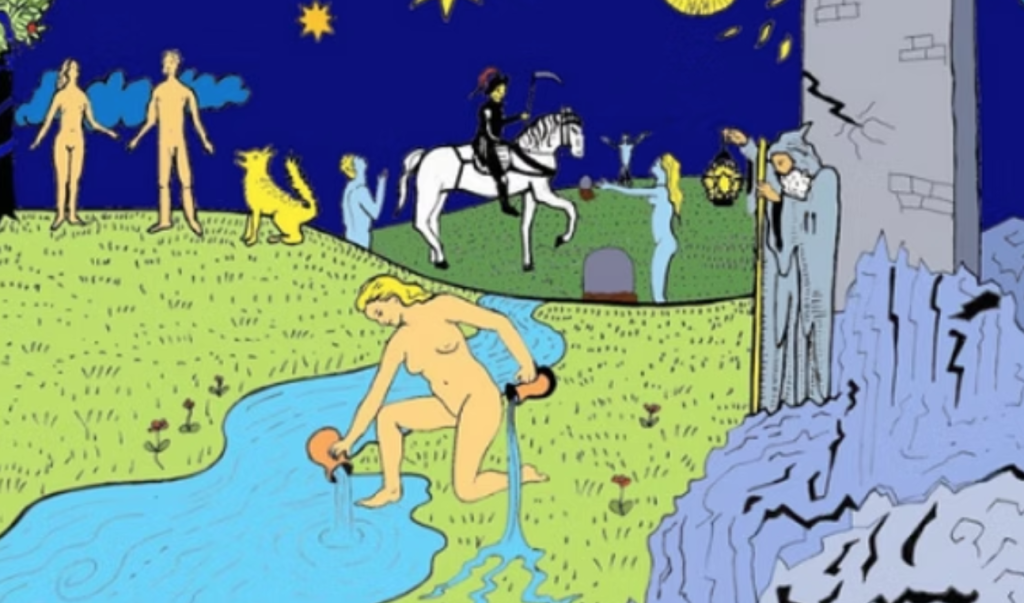
The Tower therefore succeeds because its Tarot framework gives its rock songwriting a deeper sense of purpose without overwhelming the music itself. The accompanying 42-page The Reading, unique Tarot cards for each track and artwork inspired by the Rider-Waite tradition extend the experience, but the album remains compelling even without those additional layers. At its core, this is a record about discovering what remains after familiar structures fail. Fate Envoy understand that survival is not simply about rebuilding exactly what was lost. Sometimes it means accepting that the old structure needed to fall and deciding what deserves to be built next. The Tower captures that process with urgency, vulnerability and a welcome refusal to offer easy answers.