
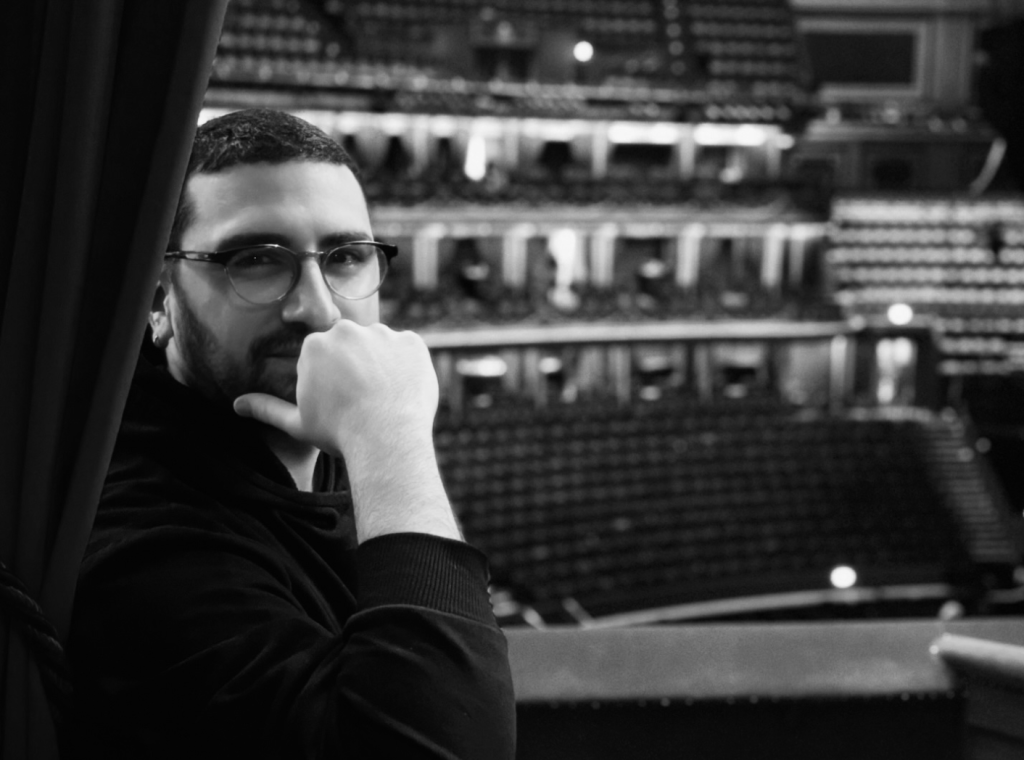

London-based composer Arın Aykut has established himself as a compelling talent in screen scoring, with work spanning Netflix and the BBC, Australian feature films, and primetime Mexican television. Working alongside Hans Zimmer’s Bleeding Fingers Music and currently completing a PhD in Composition for Film & TV at the London College of Music, he bridges a formidable classical background—as an award-winning concert pianist and conductor—with a sharp instinct for visual storytelling.
His track “Gloria”, the opening theme for the 9th season of the hit television competition Exatlón México, showcases this dual identity at its peak. Honored at the Max Bruch International Music Competition and nominated for Best Soundtrack at the World Entertainment Awards in Los Angeles, the piece builds a fierce, cinematic soundscape. It moves seamlessly between gladiatorial power and celestial choir arrangements, capturing the raw ambition of the arena.
We had the pleasure of interviewing the artist about his storytelling approach to orchestration, his work on major projects. Read it below here:
You’ve written for stage, film, and television, but your background is deeply rooted in live classical performance. When you sit down to compose today, who is Arın Aykut first: the concert pianist, the conductor, or the storyteller?
I always start as the storyteller. The piano is where my hands naturally go to find the chords, and the conductor in me constantly thinks about how an orchestra will breathe life into those notes. But the technique is ultimately just a tool. When I look at a blank screen, my primary focus is to serve the narrative and find the emotional core of the scene.
You’ve conducted symphonic orchestras and performed in historic venues. How does your background as a live performer and conductor shape the way you build tension for a primetime television score?
Standing in front of an orchestra teaches you about the physical weight of sound. Tension is not just about volume. It is about pacing, anticipation, and the collective breath of the musicians before a crescendo. I try to write for television with that live energy in mind, hoping the audience feels the human effort behind the instruments.
You often approach media scoring with the principle that music should stand on its own feet. How did you structure “Gloria” so that it tells a complete narrative before a single frame of television is edited to it?
I approach standalone themes as focused musical narratives. For Gloria, I built a clear thematic progression that begins with quiet determination, moves through struggle, and resolves in triumph. I wanted the track to have its own internal logic, so that even without visuals, the listener experiences the journey of a competitor pushing their physical and mental limits.
The choral arrangements give “Gloria” an almost divine, mythic weight. What were you seeking to evoke through those vocal layers?
The human voice connects with us on a very primal level. I used choral layers to represent the collective spirit of the athletes and the historical weight of their struggle. The choir adds a sense of timelessness, anchoring the modern physical endurance we see on screen to something much older and more universal.
The core theme of this season of Exatlón centers on relentless determination and gladiatorial energy. Which specific instruments, colors, or production choices best embody that sense of struggle and triumph for you?
I relied on low brass to establish a grounded, firm presence. French horns were crucial for the soaring melodies. To capture the physical exertion, I used driving, rhythmic string ostinatos and organic percussion. The contrast between the relentless rhythmic foundation and the expansive brass lines creates that specific gladiatorial energy.
When writing a theme for a massive television franchise, how do you balance the executive brief with your own distinct artistic voice?
The executive brief is the foundation, and my artistic voice is the architecture built upon it. The producers of Exatlón México needed high energy and scale. Within those clear boundaries, I used my classical background and preferred harmonic language to construct the piece. I often find that constraints push me to make more precise and creative artistic choices.
What draws you to stories driven by fate, ambition, and triumph?
I have a deep interest in scale, whether I am observing deep-space objects through my telescope or studying historical narratives. I am drawn to how individuals navigate massive forces. Ambition and fate are universal concepts, and writing music for them allows me to explore human endurance and the quiet moments of realization that follow big challenges.
How has working within London’s scoring ecosystem—alongside platforms like Bleeding Fingers Music and Orchestral Tools—impacted your orchestral palette and production workflow?
Working in London alongside these platforms demands high efficiency and pristine sonic quality. It has taught me to be very intentional with my studio setup. I maintain a minimalist approach to my gear, focusing deeply on mastering my primary tools rather than endlessly acquiring new ones. This discipline translates directly to a more focused and intentional orchestral palette.
“Gloria” has won at the Max Bruch International Music Competition and earned a World Entertainment Award nomination, congrats! Has this level of recognition changed your relationship with the track since you finished it?
Thank you. When you finish a piece of music, you have to let it go. The recognition is deeply encouraging, but my relationship with the track remains the same. It is a snapshot of my creative process at that specific time. The awards validate the hard work, but my daily focus is always on the next blank page and the next project.
After creating something as “Gloria”, what sonic or emotional territory are you most eager to explore in your upcoming work?
Right now, I am shifting away from the dense, high-energy sound of Gloria to explore a much darker, atmospheric territory. I am currently composing the score for an eight-episode Netflix crime series, which is an adaptation of Ahmet Ümit’s novel A Memento for Istanbul. Because it is a detective story layered with history, I am focusing less on traditional orchestral scale and more on creating psychological tension. I have been spending a lot of time recording natural, organic sounds and manipulating them to build a highly textured, mysterious sonic palette. It is a completely different approach, and I am looking forward to blending these manipulated atmospheres with a live orchestra later this year.
Follow Arın Aykut: