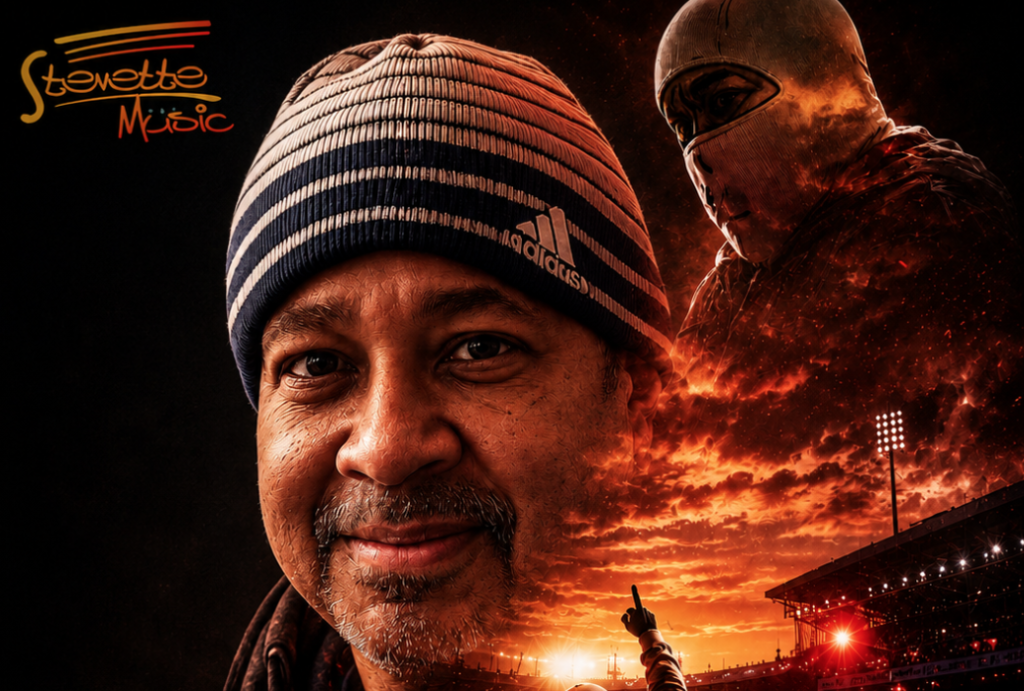
We are happy to welcome C’batch to our pages—a composer whose guitar speaks a language far beyond words. From founding Stevette Music over four decades ago to bridging analog roots with modern cinematic textures, his journey is inspiring for is artistic freedom and passion.
In this intimate exchange, C’batch opens up about resurrecting decades-old compositions, finding enduring hope in legacy, and the art of pure instrumental storytelling. Prepare to be inspired by a veteran creator who continues to redefine his craft with grace, authenticity, and unwavering devotion to the power of melody.
Dive into our exclusive Q&A below.
Your music manages to render words completely obsolete—your guitar literally acts as the lead vocalist. In a world oversaturated with vocal tracks, how do you manage to communicate such complex human emotions purely through melody and arrangement?
In this instance, the solo, which carries the melody, is purely emotional. There really isn’t much of a conscious thought process involved. I’m not necessarily thinking about how to communicate a particular emotion—I’m simply playing what I feel and allowing the guitar to speak for me.
When you dive into your archives 40 years later, how do you decide which piece of your past deserves a completely new life today?
I listen carefully to each composition and then go from there. In the past, I thought of a lot of those pieces as “just ideas.” Now, when I listen to them, I find that many, if not all, had the potential to become more fully developed works.
That’s something people had told me over the years, but at the time, I just wasn’t hearing it. Sometimes it takes distance—and maybe a few decades—to hear your own work differently.
The title subtitled “The Last Light” evokes that precise, delicate moment between darkness and hope. As a composer who has navigated decades of evolving music, what does that “last light” represent to you on a personal level?
“The Last Light” represents hope to me—a brighter and more promising future. My wife and I used to call our first granddaughter, Tytiona, our “little pooh pea.” She represented that brighter future to us then, and she still does today, as do all of our grandchildren and our great-grandchild.
So, for me, “The Last Light” is not really about an ending. It is about what continues and what comes next.
Your artistic identity seems boundless! Looking back at where you started, what core value from those early NY days has never left you?
One core value from those early New York days that has never left me is the desire to create good music and leave something meaningful behind. That was important to me when I started, and it remains important to me today.
You recently released music paying homage to legends like Ernest Ranglin after keeping ideas in your archives for 26 years. How do your encounters with other master musicians continue to shape the way you approach your instruments decades later?
If by “encounters” you mean listening to and being influenced by other musicians, there are many musicians I truly admire who have, in one way or another, shaped my approach to my main instrument, the guitar.
With respect to my chance encounter with Mr. Ernest Ranglin, that was different. I wanted to thank him for taking the time to talk with me. I never forgot that meeting, and I have always appreciated his kindness. Dedicating the project to him was my way of acknowledging both the musician and the person I had the good fortune to meet.
You and Yvette founded Stevette Music over four decades ago, building an enduring home for your art. What advice would you give to independent creators today on how to build a career that stands the test of time without sacrificing creative freedom?
One of the best ways to protect your creative freedom is to build something of your own. For Yvette and me, establishing Stevette Music gave us a place where I could create without having someone else determine what the music had to be.
For independent creators today, I would say: maintain as much ownership and control of your work as you reasonably can. Creative freedom becomes much easier to protect when you have built your own foundation.
How has your vision of what defines a “finished” song changed over time?
I’m beginning to feel that a song is never really finished. There is almost always something else that could be added to a composition. Looking back, I realize that I have always heard multiple musical elements and melodies on top of the ones already there.
When I write, I often have to tell myself, “That’s enough. Don’t make it too complicated.”
Sometimes knowing when to stop is as much a part of composing as knowing what to add.
8. You’ve bridged ’80s analog club culture with modern AI-assisted production and modern cinematic textures. Looking ahead, where do you see the future of instrumental storytelling heading?
I had never really thought of what I do in terms of “instrumental storytelling” before, but I find it an interesting concept. If that is, in fact, what I have been doing, I certainly hope there is a positive future for it.
I have always loved instrumental music, and I definitely believe that stories and emotions can be conveyed through music without the use of lyrics. After all, what is a lyric without melody? Poetry, right?
Music itself can tell a story. Sometimes it doesn’t need words.
What is the main message or feeling you hope listeners will take away from your work?
I hope listeners enjoy the music and appreciate the effort and feeling that went into creating it. Ultimately, that’s what it’s about for me—having someone other than myself connect with and enjoy what I created.
Everyone may hear or feel something different in a piece of music, and I think that’s part of what makes music so powerful.
What new musical territories or unfulfilled creative dreams are you most excited to chase next?
I’d really like to see my music used in television, film, commercials and perhaps gaming. In fact, that was one of the main reasons I started this new pursuit and journey in the first place.
Somewhere along the way, I got a little sidetracked—but in a good way. The music led me into music videos, filmmaking and visual storytelling, and those things opened up creative possibilities I hadn’t originally planned on.
But getting the music into television, film, advertising and gaming is still very much a goal. In a sense, I’m finding my way back to where this journey was originally supposed to take me.
You may also like
-
SirenBlue — Running Out of Time: The Timeless Beauty of Liberating Soft Rock
-
Exhibition by Zayfromthebay: A Hip hop Gallery of Memories
-
Lifting Your Head Again: Don Grybb’s Latest Masterpiece
-
A Nocturnal Reverie: Pocket Lint Returns with “Nyx?”
-
The Anatomy of Survival: Drums for Clowns’ Kit Cooper on Making Peace with the Noise