
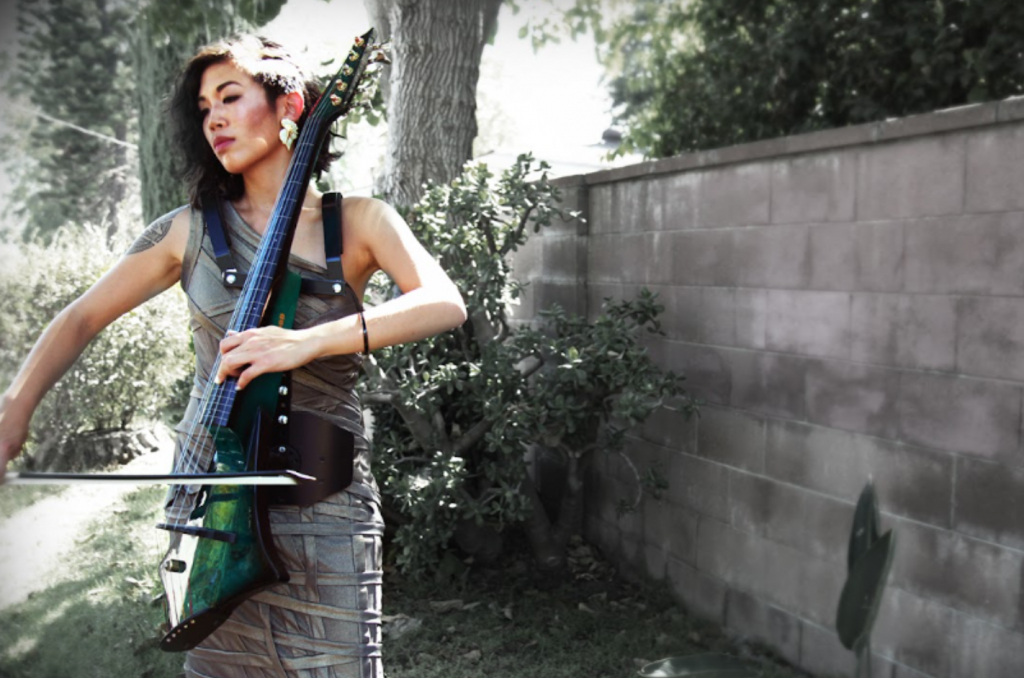
There’s a moment on “Any Other Way,” roughly three minutes in, when Dolce Wang’s guitar solo suddenly blooms into something transcendent, layered over a bed of shoegaze strings and electronic textures that seem to expand the very dimensions of the recording. It’s the kind of moment that makes you stop what you’re doing, pull out your earbuds just to make sure they’re still working, and press replay to experience it all over again. This is the magic of Wang’s debut album Any Other Way, a record that arrives fully formed from an artist who has clearly spent years honing her craft across multiple disciplines and continents. It’s shoegaze, but with cello. It’s dream pop, but with the emotional directness of the best folk music. It’s electronic, but played by actual humans with actual instruments, breathing and bleeding together in real time.
Wang’s journey to this album reads like a particularly adventurous coming-of-age film. Classically trained on cello from a young age, she nevertheless taught herself guitar, drums, and synthesizers, performing in rock and hip-hop bands while developing the genre-blurring sound that defines her work today. This refusal to be confined by genre is evident throughout Any Other Way, which moves effortlessly between intimate acoustic passages and expansive shoegaze textures without ever losing its emotional core. The international ensemble Wang has assembled mirrors this global perspective, with Serbian drummer Serge Milenkovic, Yugoslavia-born bassist Aleksandar Sasha Panich, and Taiwanese violinist Edith Lin bringing together distinct musical backgrounds to create a unified and deeply expressive sound. Together, they craft sweeping arrangements that feel both meticulously composed and spontaneously alive.
The album’s thematic heart beats with vulnerability embraced as strength, a theme that Wang explores with remarkable nuance across its twelve tracks. Written over a decade of travel, the songs draw inspiration from the people, conversations, dreams, and moments of reflection encountered along the journey. Yet Wang avoids the trap of making a travelogue, instead focusing on the universal emotions that connect us all, the shared experiences of love and loss, grief and friendship, that transcend cultural boundaries. Her lyrics are confessional without being self-indulgent, specific without being exclusionary, poetic without being obscure. “There is the life that people say you should live,” she observes, “a map already drawn, a path already named. Most of us spend years walking it before we realize we’ve been holding the paper upside down.” This realization becomes the album’s organizing principle, a refusal to follow prescribed paths in favor of charting one’s own course.
Production-wise, Panich has created a sound that honors Wang’s classical sensibilities while embracing the possibilities of modern recording techniques. The shoegaze textures never overwhelm the organic elements, and the electronic processing enhances rather than obscures the instrumental performances. The mixing creates a sense of space that feels both expansive and intimate, like a cathedral that has somehow been reduced to the size of a living room. Particular attention has been paid to Wang’s cello, which serves as the album’s emotional anchor, its voice carrying the weight of classical tradition while speaking directly to the present moment. The synthesizer textures she programs provide a counterpoint that feels futuristic without being cold, a digital complement to acoustic warmth.
What ultimately makes Any Other Way so compelling is Wang’s refusal to settle for easy answers. The album acknowledges that grief and joy coexist, that healing is not linear, that home is not a fixed destination but an ongoing process of return. This emotional honesty gives the record its staying power, making it the kind of album that reveals new depths with each listening.
Any Other Way is not just a debut album, it is a statement of intent, a declaration that there are indeed other ways to live, to love, to create, and that sometimes the most rewarding path is the one we discover for ourselves.
Instagram, Facebook, Bandcamp, Apple Music, Spotify, Website
You may also like
-
From Dancefloor Hits to Late-Night Vibes: Unlocking Nada UV’s Peach Pyramid
-
Slowlight’s Sabo Vano Is the Ultimate Sonic Detox
-
Like a Friend Singing to Your Soul: Discovering Jon-Olov Woxlin
-
Today’s Music Discovery: “Put My Trust in Jah” by INTI AYVAR WALTZ
-
SirenBlue — Running Out of Time: The Timeless Beauty of Liberating Soft Rock