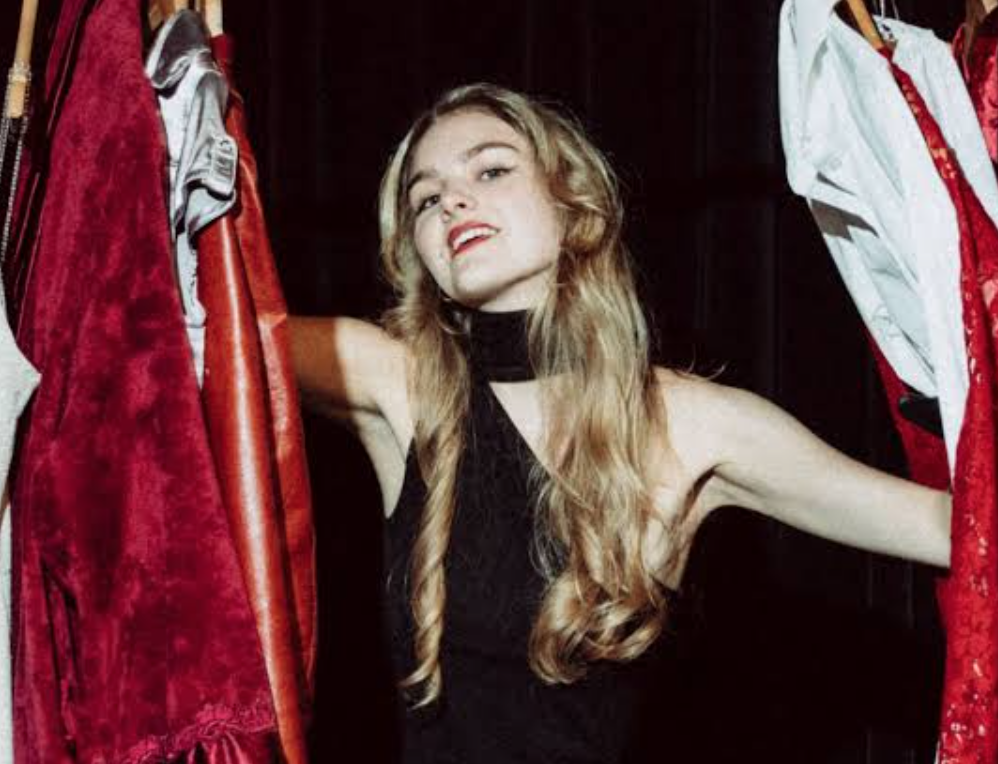
Lily Franc’s debut EP The Fitting Room approaches coming of age not as a straightforward story of discovering who you are, but as the more complicated process of discovering who you no longer need to be. Across six interconnected character studies, the 21-year-old Dutch singer-songwriter examines the expectations, relationships, fantasies and identities that people inherit while growing up, then asks what happens when those things stop fitting. The title provides an unusually effective framework for the record. A fitting room is an inherently private space, somewhere we temporarily step away from the outside world to decide what belongs to us and what does not. Franc turns that everyday experience into a metaphor for adulthood, creating an EP about trying on different versions of yourself before deciding which ones deserve a permanent place in your life. The result is personal without becoming insular, because the uncertainty at its center is something almost anyone can recognize.
The opening “burnt out gifted kids club” immediately establishes one of the EP’s most important concerns: the danger of allowing achievement to become an identity. Its portrait of a young woman whose sense of worth is tied to being capable, successful and exceptional captures the particular exhaustion that can emerge when praise becomes another form of pressure. “fun sponge” approaches emotional expectations from a different angle, using playful funk influences to explore the social pressure to appear detached or unaffected. That contrast between subject matter and sound is one of Franc’s strengths. She understands that difficult emotions do not always arrive in solemn musical packaging. “under the weather” moves into unresolved heartbreak, examining the distance that must sometimes be created before genuine healing becomes possible, while “old leather jacket” takes the familiar territory of unrequited love and turns it into something more mature. The object of desire becomes less important than the realization that self-worth cannot depend on being chosen by someone else.
The final two tracks deepen the EP’s understanding of relationships and memory. “soldier” considers emotional equality, particularly the importance of supporting another person without disappearing into the role of caretaker or rescuer. It recognizes that healthy relationships require two people capable of standing beside one another rather than one person constantly carrying the other. Closing with “for old times sake,” Franc arrives at the record’s most emotionally mature conclusion. Nostalgia is not rejected, but neither is it allowed to become a prison. The past can be loved without being repeated. Throughout these songs, Franc avoids creating obvious villains. The characters are flawed, uncertain and sometimes self-defeating, but they are also understandable. That empathy gives the EP its emotional intelligence. Franc is less interested in judging people for the ways they cope with growing up than in understanding why those coping mechanisms became necessary in the first place.
Musically, The Fitting Room reinforces this sense of experimentation and transition. Franc combines indie pop, country pop and folk with touches of Broadway and funk, while her classical violin training gives the arrangements a distinctive identity. Having studied violin since the age of five, she does not treat the instrument as an ornamental addition. It becomes part of the EP’s musical fingerprint, linking her formal musical background with the more conversational intimacy of her songwriting. There are echoes of artists such as Taylor Swift, Olivia Rodrigo, Dolly Parton, Carole King, Gracie Abrams and Joni Mitchell in the broader landscape surrounding her work, but Franc is already moving toward her own vocabulary. The Fitting Room ultimately asks a question more revealing than “Who am I becoming?” Its deeper question is whether adulthood might actually involve giving yourself permission to stop performing identities that were never truly yours. That is what makes this debut feel less like an introduction and more like a statement of artistic intent.
You may also like
-
Sporen’s Hyacinth: Pure Creativity From The Darkness To The Light
-
I am TIM x Melissa Nielsen x TOMA drop “Trippin”—unquestionably the most luminous track of the day
-
Yemi Alade reclaims her crown with “Alhaja”—a powerhouse anthem built to set every dancefloor ablaze
-
A Sanctuary in Sound: Dorian’s ‘RECONNECTED’ Is the Modern R&B Renaissance
-
Blue Capricorn Reveals New Single ‘honest’ Featuring LOREN KOLE