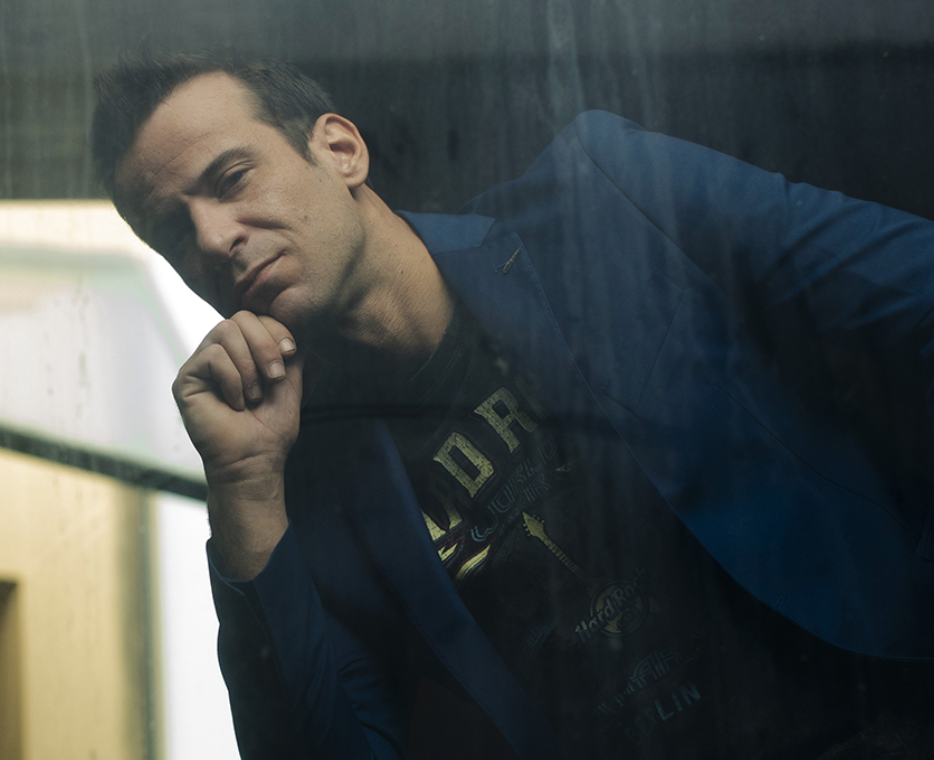
Hailing from Piacenza and now based in Milan, Richard Green is a musician, guitarist, and composer who treats music as a borderless playground.
Shaped by eleven years in London—a defining chapter that trained him as a musician—he has cultivated a rare stylistic freedom since his 2020 debut: moving effortlessly from neoclassical compositions for piano and string quartet (alongside Irene Veneziano and Archimia) to the dark, melodic hooks of “Wasted Tears” (from his January 2026 EP Electronic Therapy), as well as projects blending electro, funk, rock, and hip-hop.
In this conversation, he reflects on coming to composition later in life at 28, the essential role of silence and patience, and the quiet philosophy driving his work: channeling raw emotion into sound, never to lecture, but simply to connect—and perhaps help someone along the way.
You spent 11 formative years studying music in London before basing yourself in Milan. How has the contrast between these two cities shaped your musical DNA?
Well, basically, Piacenza—a small city close to Milan—is my hometown, the place where I grew up as a human being. But in terms of being a musician, London played an essential role. It’s the city where I studied and trained as a musician; without that experience, I would almost certainly be in another profession now.
Your music spans an incredible spectrum. Is versatility a deliberate choice, or is it simply how your mind hears music?
It’s a deliberate choice, mainly for two reasons: the search for a personal and original musical style—”my style”—and because I try to improve and push my limits every single day. That was my approach with the guitar (I’m a guitarist as well), and it’s my approach with composition when it comes to musical creativity.
Looking back, what is the biggest emotional lesson youth tried to teach you that you only understood as an adult?
I’m quoting a line I recently read in a very different context: a tennis coach retiring at the end of this year greets his student by reminding him of the “5 Ps”—Plan, Practice, Play, Persistence, Patience. Those “5 Ps” remind me of certain talks my guitar teacher gave me, someone who was a life teacher first and foremost. Behind those five simple words lies a world of meaning—something that, in my opinion, deserves to be passed on.
When you are deep in production, what does “therapy” actually mean to you—an escape or a confrontation?
Personally, making music is my way of letting out my emotions, whether they’re positive or negative. For others, though, it can be an escape from reality or from their thoughts—I think it’s very subjective.
Collaborating with classical virtuosos like Irene Veneziano and Archimia on your neoclassical trilogy must have been intense. What did the classical world teach you about silence and space in music that electronic production often ignores?
I don’t think I learned this from classical music (though working with those musicians was still amazing). My guitar teacher wanted me to understand music itself. Among his many teachings, thanks to him I understood that silence and rests are music in their own right—they’re part of it just like melodic or dissonant chords, and, in simple terms, they’re essential to sparking curiosity and interest in the listener.
If you could play one track from your catalog to the 20-year-old Richard in London, which one would it be and why?
Well, let’s say… nothing… ehehe. Seriously speaking, I started making music late, at 28. Before that, I used to create, but just to improve my guitar skills. I played in a band as a guitarist when I was younger, with no compositions at all—in fact, I’ve only been releasing music for five years.
How do you keep your identity intact when jumping so fearlessly across genres?
My identity remains intact because this is what I want to do: try to make something different by mixing several musical styles—a blend of lots of styles. Plus, I really don’t like having limits set by a specific genre.
As a guitarist by trade who ventured deep into electronic and neoclassical composition, how does the guitar still influence the way you write melodies or chord progressions today?
The guitar is fundamental. It was essential in training me as a musician and composer, and it’s still the instrument I use to practice my musical creativity, especially when creating melodies. One of my favorite things to do on guitar—something I’ve done since I was very young—is improvising solos and melodies for hours over different backing tracks. So the guitar was, and still is, my main instrument for developing my musical creativity. Now I can play piano and bass as well, though certainly not like the guitar, where I have almost 20 years of practice.
When a listener puts on your track in a dark room with headphones, what do you hope they forget about the real world?
I’m not, and don’t want to be, someone who tells others what to think or how to forget about this world. My only hope is that I can help someone with my music.
If Wasted Tears and your neoclassical trilogy represent different chapters of who you are, what is the ultimate truth about yourself that you are still trying to figure out through your art?
For me, music isn’t just an inner search—even if the neoclassical project is very personal and strongly reflects parts of my thoughts on life. My music is also a way to speak, to communicate, and perhaps, as I mentioned above, to help others.
You may also like
-
Between Shadow and Light: Diving into the Striking Universe of ÐЯЭΛԁᵽāɪɪ
-
The Art of Feeling Too Much: An Exclusive Interview With I Ya Toyah
-
Echoes of Grace: Don Grybb on Finding Hope, One Breath at a Time
-
The Anatomy of Survival: Drums for Clowns’ Kit Cooper on Making Peace with the Noise
-
“Touch Your Heart and Set Your Hair on Fire”: In Conversation with Neil C. Young Trio