The French music scene in 2026 has a clear anomaly.
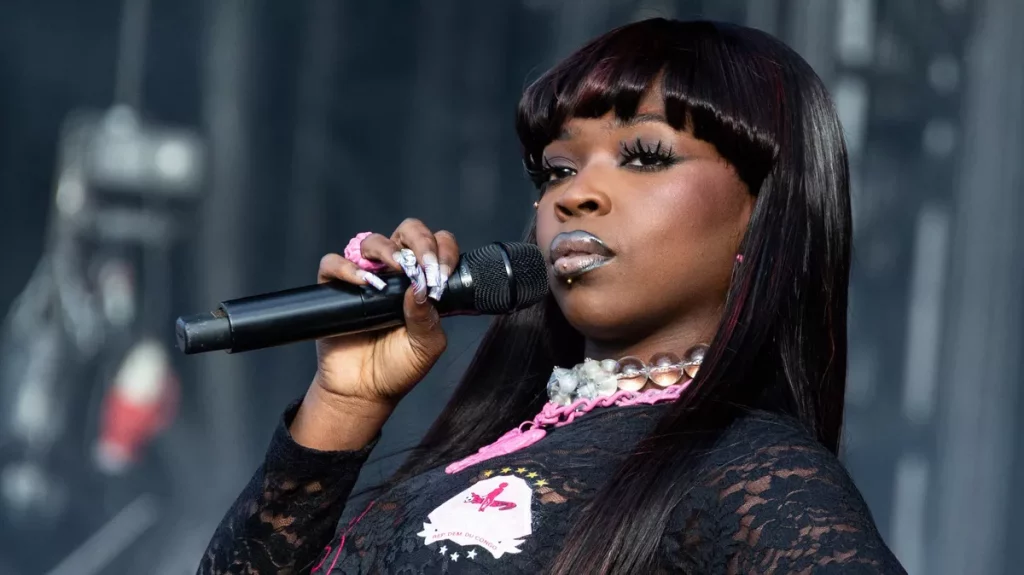
Her name is Theodora, aka Miss KITOKO, 23, and she doesn’t behave like an “emerging artist” in the traditional sense. She behaves like a system glitch — one that somehow became the system.
In less than two years, she’s moved from internet curiosity to cultural pressure point. In France, she provokes debate. Outside of it, she reads like something more familiar: a hybrid pop figure shaped by post-TikTok attention economies, hyper-visual storytelling, and the collapse of genre borders.
The question is no longer whether she fits in French pop.
It’s whether French pop can contain her at all.
Trying to categorize Théodora’s music is, at this point, a losing game.
What travels internationally is not a “sound” in the conventional sense, but a stack of references: Afro-influenced rhythms, trap minimalism, hyperpop distortion, and a vocal delivery that oscillates between intimacy and provocation.
Her “MEGA BBL” project doesn’t behave like an album rollout. It behaves like a curated identity layer — part performance, part meme logic, part sonic collage.
From an outside perspective, the most notable element isn’t even the hybridity. It’s the intent: a deliberate rejection of coherence.
She has described her audience as “girls who feel a bit out of place,” which, translated into global pop language, situates her closer to artists like experimental alt-pop figures who treat femininity not as aesthetic but as disruption.
What stands out is not whether it is “good” or “too much,” but how unapologetically it refuses moderation.
Inside France, Théodora is polarising in a very local way: lyrics considered too explicit, visuals described as excessive, and a public discourse that still negotiates what “urban pop” is allowed to look like.
But from an international lens, the reaction is instantly recognizable.
This is the same cycle seen across multiple markets: algorithm-fueled visibility, backlash framed as morality critique, then escalation into performance controversy.
Recent episodes — online smear narratives amplified by automated accounts, and a tense festival performance where she was booed on stage — read less like a uniquely French scandal and more like a textbook case of platform-era celebrity volatility.
What differentiates her response is tone.
Instead of retreating into PR containment, she meets the moment with irony, social media immediacy, and a kind of detached humour that feels native to the same internet that made her visible in the first place.
In that sense, she is not “cancelled” or “saved.”
She is continuously circulating.
After a series of sold-out indoor shows earlier this year, Théodora is now embedded in the European festival ecosystem — the circuit where new pop legitimacy is often tested in real time.
For international observers, what matters less is the individual billing and more the pattern: she is no longer positioned as a domestic “rising act,” but as a touring cultural object moving through one of Europe’s densest festival networks.
What Théodora represents — whether one likes the music or not — is a familiar 2020s archetype in a French context: an artist whose career is inseparable from online discourse, aesthetic fragmentation, and continuous controversy loops.
She once joked that “no one like Marine Le Pen is dancing to her music.”
It lands less as a political statement than as a marker of segmentation: she is not aiming for universal approval, and doesn’t need it.
From the outside, the most striking element is not that she divides opinion.
It’s that division appears to be part of the design.
And in that sense, Théodora is less a pop star than a signal — constantly transmitting, constantly misread, constantly impossible to stabilise.