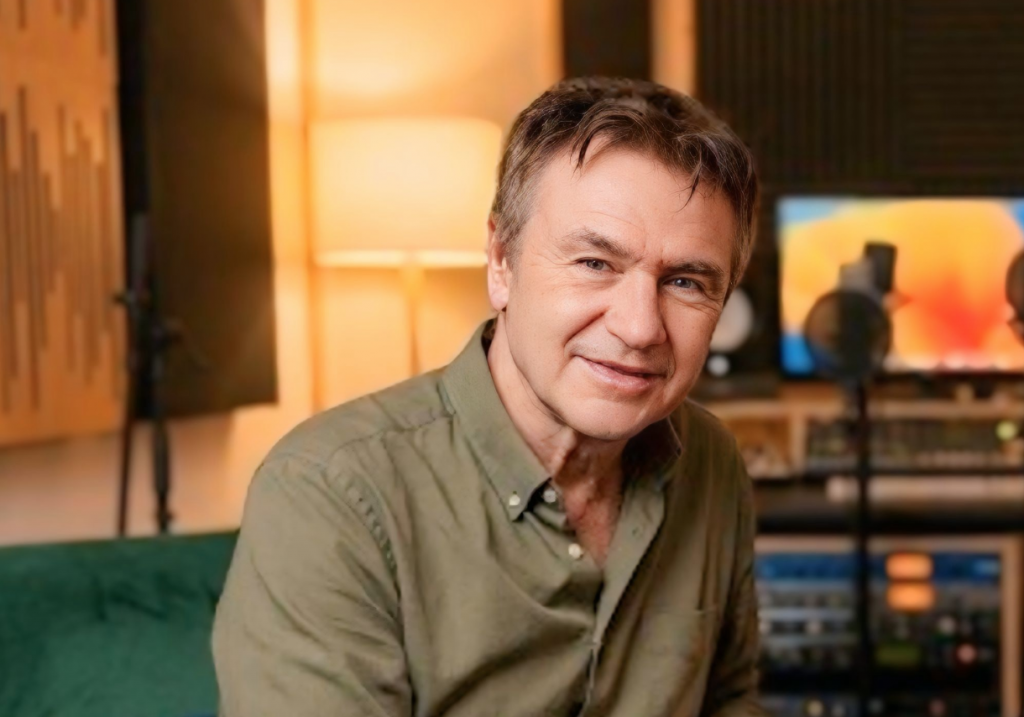
Following our review, we had the privilege of speaking directly with Serge Gorbman Project aka SerGo. A veteran sound engineer with over 25 years spent shaping soundscapes behind the console, he opens up about the genesis of this deeply intimate and ambitious venture.
From rediscovering the blues as a gateway to artistic liberation to mentoring vocalist Ofri Afek (Farewell Song) from scratch, Serge Gorbman shares a captivating vision of music—balancing digital precision, metaphysical depth, and the irreducibly human element in the age of AI. A fascinating look into the mind of a unique creator.
Read the full interview below!
After 25 years behind the console shaping soundscapes for others, what does the Serge Gorbman Project allow you to express that you had to keep quiet until now?
Although the original foundation for this song was written 25 years ago, I always felt that its inner potential was far greater than its initial realization. Back then, I didn’t yet know how to express what remained hidden, so I set it aside, trusting that understanding would come with time.
As a musician constantly in motion, I continued to learn, exploring various musical and poetic disciplines. Eventually, I realized the core issue lay in internal creative freedom—I needed to expand my consciousness. That realization brought me to the blues. Spending hours improvising, I began to see the blues not merely as a genre, but as a tool: a gateway to a deeper realm of artistic liberation. A second breakthrough came when I began perceiving poetry on a metaphysical level—memorizing poems with multiple layers of meaning and attempting to interpret and build upon them. Once I was truly ready to speak with a new voice, everything fell into place: the perfect vocalist appeared, and modern technology gave the track its final life.
We discovered you with Farewell Song feat. Ofri Afek, which has that rare ability to “bend time.” After 25 years in the studio, at what exact moment does a production stop belonging to its era and become truly timeless?
That is the million-dollar question. What transforms a piece into something timeless that pierces through history? It happens when we cease merely reading letters and listening to notes; when a director films a visceral feeling rather than just a plot. When music detaches from the ground, a different, metaphysical understanding of the world emerges—and the laws of perception change. Everything that “bends time” possesses this extra attribute of Ariel: a flight high above physical space. Only time itself has the capacity to read this attribute. As for us, we can never truly predict how our word will echo.
You bring new life to vintage compositions through modern cinematic sagas. How do you navigate the balance between honoring the memory of an original piece and the urge to completely reinvent it?
I am the memory of that original piece. Today, I look back with immense tenderness at my younger self who wrote it. Yes, I managed to take flight back then, but perceiving and capturing the metaphysics of the composition was still out of reach. There are prodigies who possess the gift of bending time almost from birth; for me, it required a long journey simply to reach a place of self-awareness where I could comprehend these processes.
Your sound carries the warmth of classic “Adult Standards” alongside modern digital precision. Is the studio a tool for you to recover a lost sound, or to build an acoustic future that didn’t exist yet?
Popular music is deeply—if not entirely—dependent on contemporary sound. If one chooses to play retro, it must be executed through modern sonics infused with the spirit of that past era. For me, it is less about recovering a lost sound and more about recapturing the pure inspiration originally poured into the song. I am convinced that this inspiration can magically resonate through modern digital precision—provided, of course, that it was truly embedded there in the first place.
We’re living in an era where AI can emulate technical perfection in seconds. As a master engineer who has spent 25 years perfecting high-fidelity production, what do you think is the one human element in music crafting that technology will never be able to automate?
Technical perfection in itself is like falling in love with a model’s appearance, or marvelling at a pianist whose hands move so fast they become a blur. When technical mastery becomes the ultimate goal, music devolves into a athletic accomplishment. What truly matters in music is the power of the core idea. Take the famous motif of Beethoven’s 5th Symphony: short, distinct, followed by 34 minutes of brilliant variations. A powerful core idea yields inspired development; a weak idea produces only weak variations. AI is well-informed and trained on existing material, but it lacks the non-linear thought process required to contemplate what lies beyond human experience. AI can skillfully develop a given concept, but if fed weak ingredients, that skillfulness exudes a dreary emptiness. An inspired core idea is a musical thought with a metaphysical presence. That is the one irreducibly human element in music—at least for now.
Your music feels as though it “quietly repairs something within us.” When arranging a track, are you conscious of initiating a form of emotional healing, or is that just the unintended byproduct of a technical obsession?
Consider the honeybee: a relentless worker producing honey without consciously contemplating its healing properties. Musicians are much like bees, except we are driven by an irresistible urge to immediately share the idea that struck us—a new melody, a new spark. In essence, we share the elevated state of mind that occurred during the creative act, a state that inherently carries a gentle, healing quality.
What kind of sanctuary are you trying to offer the listener?
The universe is built on harmony, encompassing both consonance and dissonance. Yet, realizing that dissonance in life is simply part of a larger global harmony is a gift given to few. Musicians naturally construct their own metaphysical reality—it is essential for the creative process. It is difficult to express this directly in words, let alone convince anyone, but it can be shared implicitly through music. A successful song is a direct manifestation of universal harmony. When a listener truly immerses themselves in such a piece, they find themselves under the harmonic protection of a higher power.
After a quarter-century as a producer and audio engineer, what technical certainty did you have to unlearn to make room for the Serge Gorbman Project?
I had to struggle to abandon the comfort of working with established, professional session vocalists. The problem was within my own vision: I knew precisely the vocal timbre I required, yet I couldn’t find it anywhere. Experienced vocalists excel at what they already know, but pushing beyond—reaching a raw sincerity and unexpected stylistic versatility—is often outside their scope. So I decided to cultivate vocalists from scratch. No one believed in this idea, but I established my own vocal class for selected young talents. Ofri Afek came to me at age 12, completed a full course in modern vocal technique under my guidance, and this year, at 18, recorded two songs. And she is not the only one.
Your upcoming single is titled Moody Melody. Autumn is a season of transition and shifting light—what specific mood or memory are you aiming to evoke with this next release?
Autumn naturally mirrors the shifting mood of this track, which is technically reflected in its rhythmic transition from a 6/8 verse to a 4/4 chorus. At its core, the song is about maintaining dignity within a rough around the edges world. Musically, it grounds itself in classic Soul and vintage R&B—an era when relationships were wrapped in a cinematic, Hollywood mist. It balances dreamy illusion with a grounded moral perspective. The protagonist is a modern woman, a “queen in a t-shirt.” Though she embodies the magic of a bygone era and radiates a high frequency, the friction between eras remains, expressed through shifting moods. “Modern love is a flash of egoism,” she reflects—and as listeners, we follow her journey and understand her inner world.
When the final note of your musical journey fades out, what is the feeling you hope is left hanging in the air?
I have always been fascinated by ideas that unite people through a sense of spiritual togetherness. Nations evolve through their unique heritage—just as artists at Eurovision sing in their native tongues, reflecting the spiritual essence of their people. My ultimate creative ideal is to craft an inspiring song that resonates within vastly different hearts. I hope fragments of this message remain floating in the atmosphere. Put simply: musicians don’t disappear—they simply turn into sound.
You may also like
-
Where Classic Soul Meets Modern Technology: R.Nelson on Music, AI, and Emotion
-
Inside In Spirit: A Conversation with Lana Crow
-
Arnito: Inside the Mind Behind Musiques de mon monde, Vol. 4
-
Young V on Ambition, Manifestation & Building a Life Bigger Than Limits
-
Interview: Why m0n0 jay Became One of Our Favorite Discoveries