
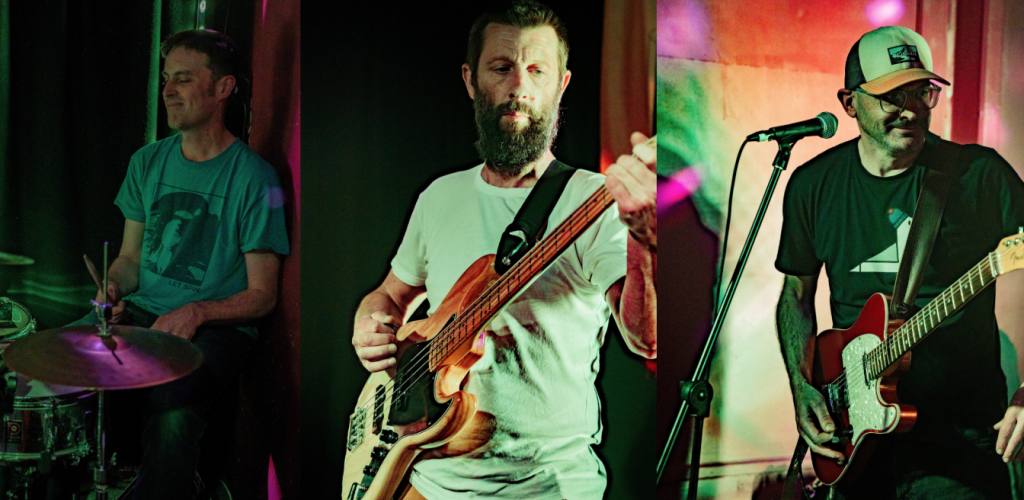

Today, we’re thrilled to sit down with the Neil C. Young Trio, the North West England-based outfit redefining the boundaries of modern fusion. Known for their ability to blend jazz, rock, and indie pop into a groove-heavy sound that can “touch your heart and set your hair on fire,” the trio is taking things a massive step further with their upcoming EP, ReWorks Vol. 3.
Trading conventional trio setups for dense FX pedalboards, doubled bass lines, and sweeping post-rock landscapes, the band takes iconic pop and hip-hop structures and turns them completely inside out. We caught up with Neil and the trio to talk about their sonic evolution, balancing technical complexity with raw emotion, and navigating the industry on their own terms.
Dive into our conversation below.
Before we dive into the new sounds, who is the Neil C. Young Trio when the instruments are put away—and what core belief brings the three of you together?
On this recording, the trio is made up of Neil C. Young on guitar, Sam Dale on bass, and Ben McCabe on the drum kit. We are always aiming to improve, explore, develop, and keep an open ear for what else we can express or discover musically, whether in our rehearsals or live sets.
Moving from the more conventional trio instrumentation of your earlier work to the heavy FX boards and dense Post-Rock fusion on ReWorks Vol. 3, what was the exact turning point for taking this leap?
There wasn’t an exact turning point, but rather a gradual development since our earlier recordings—driven by the sounds forming in our heads that weren’t accessible with the gear we had at the time. The biggest change was getting hold of the EHX SuperEgo+ pedal with its freeze capabilities, which is now a fundamental part of the sound we generate. Other bits and pieces were added to that, but there is definitely a wet and dry signal path going on with the guitar and bass tones.
Your music avoids standard genre templates. How do you maintain such an effortless groove while pushing into unpredictable territory?
Oooo, thank you! I think each arrangement inherently offers us the chance to get into the groove of the track before heading off to wherever the moment leads. Listening to each other is vital. Although there may be times when responsive listening isn’t happening for all of us simultaneously due to intense focus on an individual part, there are always at least two of us holding down the interactive, groove-maintaining work. Also, overcoming the anxiety surrounding tempo changes when playing—especially during improvised sections—was a huge breakthrough. As long as we’re collectively locked into that groove, the fact that the tempo moves up or down isn’t a problem.
Taking on longer track formats demands a different kind of storytelling. How do you sculpt tension across an extended arrangement to keep listener energy locked in?
It’s about allowing time for ideas to develop while remaining aware of what makes them unique, and then working away from them to create contrast and maintain a sense of journey for both us and the listener. Sometimes these contrasts are slow burners, where a new idea emerges from a pattern one of us stumbled upon 5 or 10 minutes in. Other times, there’s a more direct shift that ties closely into the overarching structure of the track. Having a strong awareness of the balance between the various musical and technological elements plays a big part in the story, as does having a clear sense of direction—whether pre-determined or emerging naturally as the improvisational sections unfold.
ReWorks Vol. 3 reimagines iconic pop and hip-hop structures. What draws you to these specific genres, and how do you strip them down to fit your fusion universe?
It was the individual tracks that drew me in. From there, it was a case of working them out in their original forms, which then sparked ideas for the ReWorked versions. “Crazy For You” is built around a backing vocal hook from the original outro that I found while transcribing the track; it became the core bass/guitar riff running throughout, maintaining the same rhythmic quality while the tonal elements shift through the harmony. “Baby Blue” by Action Bronson takes a more direct approach, swapping the original rapped verses for improvised instrumental sections before extending the chant and horn section at the end for further improvisation and harmonic shifts. “Almost Blue” required a completely different approach. Originally a slow jazz ballad, I wanted an arrangement that kept our signature doubled bass/guitar riff, highlighting the push-pull and frustration of temptation. The harmonic sequence remains fairly faithful to the original, but it’s presented in a more linear way through the melodic line and the accompanying bass/guitar line beneath it.
You’ve described your sound as something that can “touch your heart and set your hair on fire.” How do you balance raw emotional resonance with technical, high-octane performance?
Our collective aim is to generate an expressive, emotional experience—something we feel while playing that hopefully conveys to the audience. The technical aspects are hugely important, but our balance tilts toward expression rather than absolute perfection of intended lines. Because we’re improvising, even when there are prescribed parts to play, we’re always looking to see where else we can take things once those foundations are set. There will always be moments where the technical side feels slightly out of control; however, those moments either fuel the very next second of the performance or shape our next rehearsals. That’s why recording as much as possible is vital—so those moments aren’t lost or forgotten, but built and developed upon.
Heavy FX pedalboards can transform an instrument completely. Do these textures spark the compositions, or are they added later to paint over an established groove?
Mainly, they are brought in after the core arrangement ideas have formed to enhance the experience and overall journey of the track. However, as we use these pedalboards more, new textures are emerging that serve as the spark for fresh material—either to use within live renditions of these tracks or to set aside for future original releases.
Coming from North West England, how does your local scene and regional background shape your fearless approach to genre-bending?
In our part of the world, there’s a strong culture of doing what you want to do and pushing yourself to keep going. There has always been a supportive attitude across the local musical community, which we deeply appreciate. It keeps encouraging us to push our ideas, refine our sound, and challenge genre boundaries.
When you’re navigating complex arrangements, how do you know a studio take has captured the right soul, beyond just technical perfection?
It’s hard to quantify, but as cliché as it sounds, you just know. Sometimes the engineer gives you that look that says, “That’s the keeper,” or the three of us share a collective grin that says, “That’ll do for me!” Beyond subjective feeling, we play these tunes a lot—in rehearsals and live—so we have a clear idea of what we’re aiming for. Even so, that doesn’t guarantee a flawless performance; things can get a bit wonky! Ultimately, the balance we seek is weighed toward capturing the soul and expressive nature of a track rather than technical perfection. You can play every note accurately, but if the emotion isn’t there, we’ll simply take it again.
Looking ahead, what do you hope people take away from ReWorks Vol. 3, and how do you see the Neil C. Young Trio evolving within an industry that often tries to put genre-bending artists into a box?
Hopefully, people will enjoy what we’ve created, embrace the new directions we’ve taken with these established songs, and discover something new with every listen—and, of course, go back and check out our earlier releases! As for us, we’ll keep going, searching for ways to develop both expressively and technically. Fitting into a specific genre isn’t a concern for us; we just want to keep enjoying the process of making and performing our music.
You may also like
-
Album Review: Nathaniel Sutton’s The Days – A Warm, Poetic Journey Through Indie Soundscapes
-
From Dancefloor Hits to Late-Night Vibes: Unlocking Nada UV’s Peach Pyramid
-
Slowlight’s Sabo Vano Is the Ultimate Sonic Detox
-
Like a Friend Singing to Your Soul: Discovering Jon-Olov Woxlin
-
Today’s Music Discovery: “Put My Trust in Jah” by INTI AYVAR WALTZ