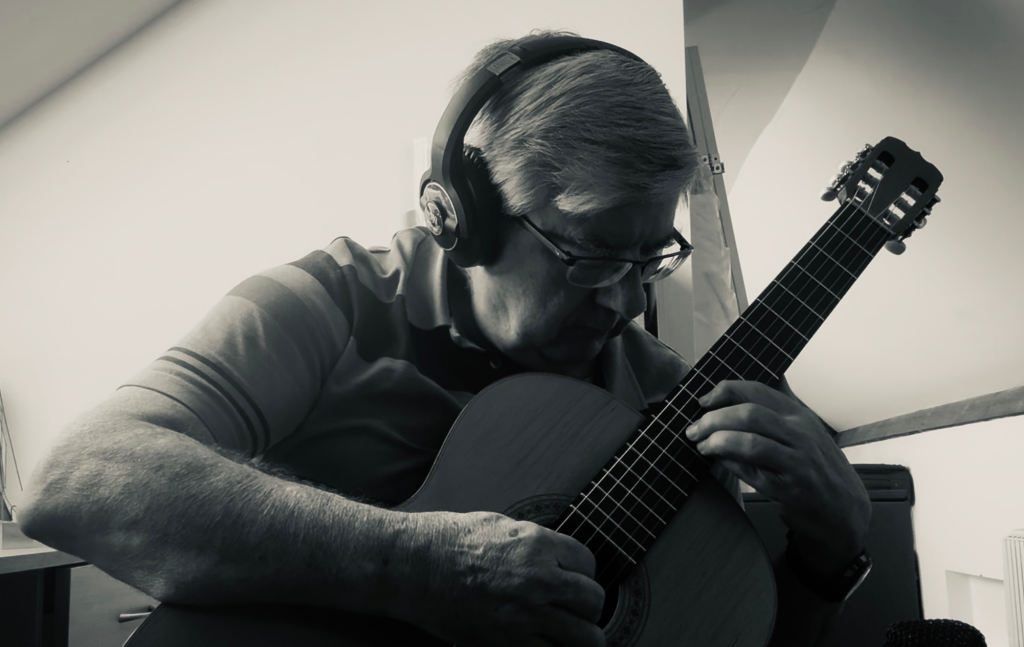
After being deeply moved by the quiet beauty of Hidden Andalucia, we knew we wanted to meet the artist behind it. We had the pleasure of interviewing Martin Lloyd Howard, a musician whose work invites listeners to slow down, reflect, and embrace the power of simplicity.
In our conversation, he shares the inspirations behind his music, his creative journey, and the unique way he allows emotion to become part of the composition.
Your music often feels as though it exists outside of time. When you’re composing, are you trying to capture a specific moment, or create a space where time simply disappears?
I don’t think I am trying to capture a particular moment. It’s more about attempting to capture a mood or painting a picture in the minds of listeners. Sometimes that is the clear intent behind the composition and sometimes it just emerges as I pursue a specific musical idea.
Listeners frequently describe your compositions as calming or even healing. Is offering a sense of peace something you consciously aim for, or is it simply a natural consequence of writing honestly?
It’s good that listeners react in that way. Most of my music is about generating positive and/or relaxing vibes, but sometimes it is geared more towards sadness (eg Chanson Triste) or tension and mystery (eg The Dark Glen).
Silence seems to play just as important a role in your music as the notes themselves. How do you know when not to play?
It’s a really important point. Knowing when to let the guitar breathe is largely instinctive, but years of experience also help. It can take time to learn that not every moment in a piece needs to be filled with a flurry of notes. When I listen back to some of my earlier work, I plead guilty to doing just that.
Your latest work brings together the elegance of John Dowland’s Elizabethan tradition and the expressive spirit of flamenco. What fascinated you about placing these two musical worlds into conversation with each other?
I love both musical traditions. By and large, Dowland style music is quite highly structured, whereas flamenco is more improvisational and there are of course centuries of time between when each style emerged. But I felt that there was enough commonality to make it possible to merge them by using an F5 chord to act as a bridge between the E minor flavour of the Dowland part and the E Phrygian dominant scale used in the flamenco section. And it seemed to work pretty well.
You’ve explored classical, folk, blues and rock throughout your career. Rather than seeing them as separate genres, do you feel they all speak the same musical language beneath the surface?
It’s a bit of a cliche to say that it’s all music, but it is nevertheless true. To some extent the unifying factor for me is the use of the guitar, both electric and acoustic. It is the most versatile of instruments and an excellent vehicle for crossing the boundaries of musical genres. I doubt I would have gone down that road if I had played violin or saxophone.
You perform on a fifty-year-old handmade classical guitar with a remarkable history of its own. Has living with the same instrument for so many years changed the way you compose or even the way you hear music?
Hard to say really. I don’t think having such a special guitar changes how I listen to music. But it is an essential part of the compositional process, even for pieces which are eventually recorded on different guitars, mainly because I am so comfortable playing it.
Your compositions leave plenty of room for the listener’s imagination, allowing everyone to create their own story. When you write, do you picture landscapes, emotions, memories—or do you deliberately leave those images undefined?
As I said in answer to your first question, sometimes I have a picture or a mood in my mind when I start the compositional process. But more often a project starts with a musical idea and the imagery/feeling gradually emerges. It’s also important to say that this is what I see. If listeners agree that is great, but if the music provokes different pictures or emotions in people that is also completely valid.
In a musical world where speed, algorithms and constant attention often dominate, your work invites listeners to slow down and simply listen. Do you see your music as a quiet form of resistance to modern listening habits?
Maybe, but it’s not a conscious stance. Basically, I compose music the way I do because that’s what I find easy to do. I could no more write or perform dance or hip hop music than fly in the air. And although those and other contemporary genres are mostly not to my taste, they are completely valid and challenging forms of musical expression which deserve respect. So perhaps I’m not much of a rebel!
Having worked both as a solo guitarist and in collaboration with other musicians, what do you enjoy most about each experience? Does working with others ever reveal something about your own musical voice that you hadn’t noticed before?
I get huge satisfaction from both solo and collaborative work. There are obviously things in common mainly around the development of musical ideas, but what I particularly enjoy about collaborative projects is the to and fro between me and people like Mark Johnson, the opportunity to be something of a multi instrumentalist rather than just a guitarist and the technical challenge of mixing and mastering multiple tracks into a cohesive end product.
We’ve had the pleasure of following your musical journey more than once, and each release reveals another facet of your artistic identity. Looking ahead, is there a musical tradition, instrument or unexpected collaboration that you’d still love to explore?
I’m probably a bit long in the tooth and stiff in the fingers to try and learn a new instrument, though occasionally I hanker after the idea of learning to play a lute. I’d also like to improve my electric and bass guitar playing. In terms of collaborations, I’d love to work with a violinist, cellist or saxophonist though I have no specific plans in place for that. And in terms of style I will shortly be returning to the world of altered tunings with a new piece called Highland Mist to be played on a steel string acoustic tuned to DADGAD. Watch this space!
You may also like
-
From Dancefloor Hits to Late-Night Vibes: Unlocking Nada UV’s Peach Pyramid
-
Slowlight’s Sabo Vano Is the Ultimate Sonic Detox
-
Like a Friend Singing to Your Soul: Discovering Jon-Olov Woxlin
-
Today’s Music Discovery: “Put My Trust in Jah” by INTI AYVAR WALTZ
-
SirenBlue — Running Out of Time: The Timeless Beauty of Liberating Soft Rock