
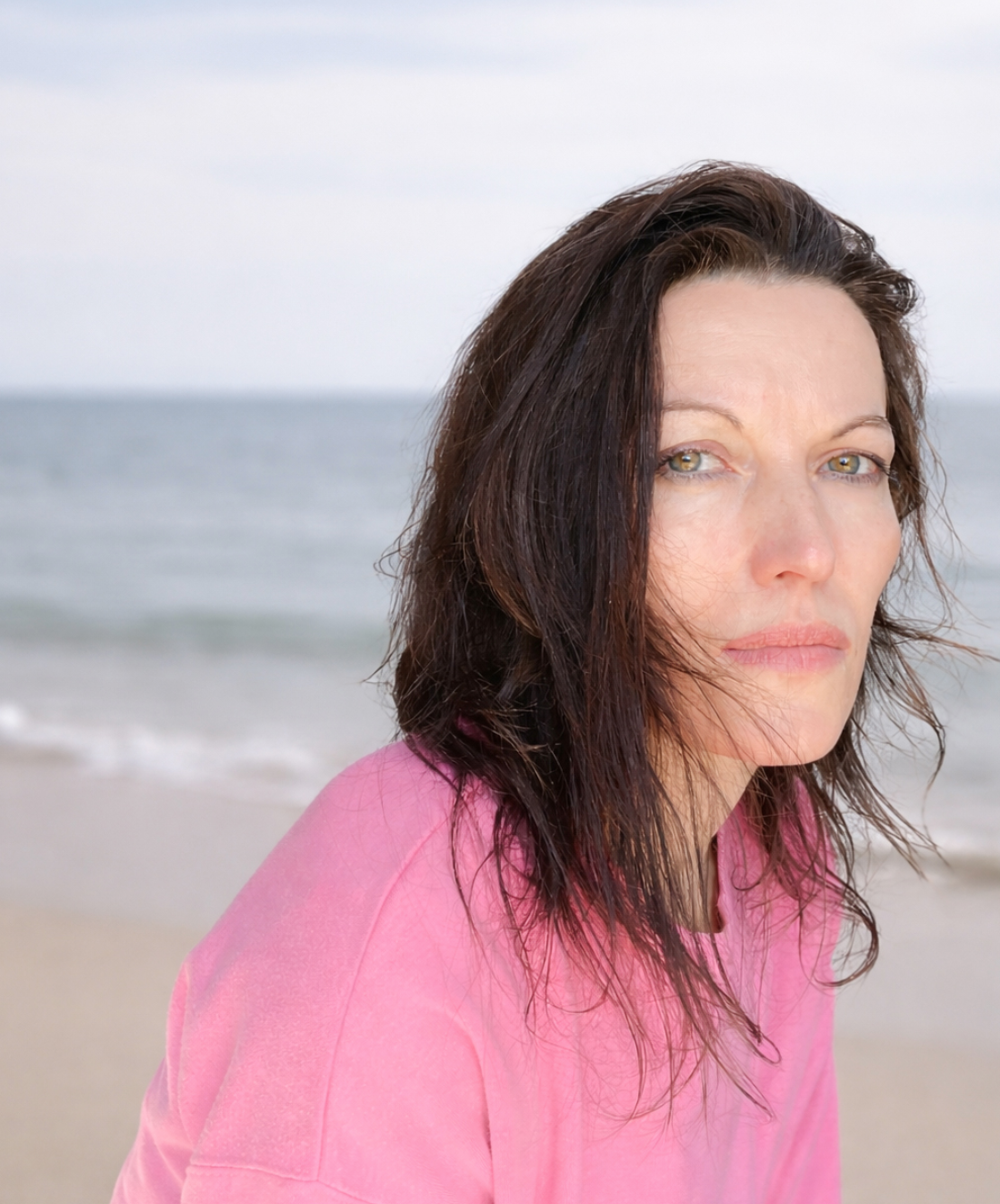
Today we are happy to share ou conversation with Lana Crown, discovered recently with her album “In Spirit”. In this interview, she opens up in a very honest and grounded way about her creative process, her relationship to truth, and the experiences that shape her writing. A clear and human conversation with an artist who turns inner life into sound.
In Spirit sounds like an emotional landscape. If listeners could physically step inside one song from the record, which one would you want them to live in for a day — and what would they discover there?
Definitely “In Spirit”. I would love everybody to find their magic!
Your music often feels like a conversation whispered in the middle of the night. Do you write songs to understand yourself, or to finally say things you could never express in real life?
It is the second one. I understand myself quite well now, but it took me a long time to get there. I, like so many of us, lived a lie about who I was. It was hard to admit that I contributed to my own pain as much as other people did, but taking responsibility for your own outcomes is the most freeing exercise in the world.
Yes, some of us are born into harsher environments than others and the results of that are impossible to ignore. However, one thing applies to most of us: we are indoctrinated to believe that we are victims of outside circumstances, when in fact the opposite is true. Because of this initial indoctrination, we proceed to live our lives exactly like that—as victims. Too often we fail to understand one simple truth: life is a collection of clues and nudges that surround us, but we ignore them when we are ruled by pride and ego.
This message—that you are the creator of your own life and a contributor to creation as a whole—is what I am trying to weave into my songs.
You’ve described In Spirit as a search for clarity beyond the noise of modern life. What is the “noise” you personally struggle the most to silence?
It’s mainstream propaganda. It is completely insane nowadays, and it’s scary to see how easily people can be manipulated. Having been born and partially raised in the Soviet Union, I’ve seen the long-term effects of this firsthand. My own great-grandmother lived under Stalin, yet I watched her lived experience get dismissed by generations born decades after her. I could go on and on about it, but in short, the one thing I’ve learned is this: when something is overly protected from scrutiny, it is rarely innocent—and the reasons behind that protection never are either.
Another aspect of the ‘noise’ I struggle with is how aggression is getting normalized these days. No, there is no special cause that can excuse aggression; things are much simpler than they are made out to be. Being aggressive does not necessarily make you a bad person—we all go through dark patches in life—but it certainly does not make you virtuous. I see people getting attacked just because their opinion or actions do not comply with the mainstream narrative, and it is quite frankly a frightening thing to observe.
Being born in Kazakhstan, raised with classical piano, and creatively reborn in the Spanish countryside creates such a unique inner geography. Which place do you think still echoes the loudest inside your music today?
It isn’t so much one place as it is the culmination of experiences that forced me to re-evaluate how I view myself and the world. I was born in Kazakhstan during the Soviet era and experienced its collapse. Economically, the country changed overnight, but the mentality didn’t. I watched different generations carry variations of USSR indoctrination that never went away. Under socialist rule, where everything belongs to the government, you are only as valuable as you are productive. It causes deep psychological damage, which is why it’s shocking to see socialism romanticized today. To me, this romanticization makes no sense because on a logical level socialism simply cannot work: it is modern-day slavery. It enslaves you mentally even more so than physically and it is incredibly hard to shake as it dresses itself up as a virtue, penetrating deeper than anyone realizes.
When I moved to the West, I noticed a profound difference: people respected themselves, which allowed them to respect others. I lived in Germany and the UK before finally settling in Spain, mixing with immigrants and locals alike. While that cultural exposure really matured me on several levels, I was still unconsciously carrying the heavy weight of my early conditioning. Many years and painful experiences later, I finally unraveled it. My life changed dramatically. I found my voice, literally—and that exact transition from having no voice to finding it is what shapes my music as a whole.
“So Done” carries both exhaustion and healing at the same time. Was there a specific moment in your life where you realized vulnerability could actually become a source of strength?
I am not sure about a specific moment, but it is true that admitting vulnerability can be empowering. It is the moment when you stop lying to yourself. It’s an ‘it is what it is’ realization that sends a powerful message to your brain: it’s okay to be exactly who you are.
Your songs feel deeply cinematic, almost like fragments from a dream journal. Do visual images appear in your mind before the music exists, or does the music create the imagery afterward?
There are two ways I tend to ‘receive’ a melody. The first is when I set a conscious intention to write about a specific theme. The second is completely random—the melody simply comes to me in a dream or during waking hours. When it happens randomly, the music itself dictates the mood, and I visualize scenarios based on what I’m hearing. Ultimately, the creative route looks either like melody > visualization > lyrics or visualization > melody > lyrics. Lyrics always come last.
After stepping away from music for a long period, did returning to songwriting feel comforting… or terrifying?
I never wrote a tune before four years ago. I did not imagine I would ever be able to write music; it was not something I considered possible—not even a 1% chance. Music school taught me to play piano, and that was it. I only spent a couple of years there, though, because I was hospitalized for a few months. After that, I had two options: fall a year behind my class or leave the school. I chose leaving, as I did not have the stamina for this extra activity anyway. As of today, my music theory knowledge is minimal, but I can compose. So, I did not really return to songwriting. It was a brand new and totally unexpected endeavor, and yes, it was scary because it was uncharted territory.
There’s something timeless in your sound but it never feels nostalgic. What emotions or atmospheres are you chasing more than genres?
I am chasing empowerment through sound. I don’t mean the kind of empowerment that pushes people to seek control over everything, but rather the strength that comes from taking responsibility. If you’ve done something wrong, the reality is that the moment you admit it, you’re already on a path of living a more fulfilling life. In fact, I often find that other people will forgive you much quicker than you can forgive yourself once you express genuine regret. So yes, empowerment through embracing responsibility is exactly what I’m after. But I also want this music to send a clear message to listeners: you are never truly alone, even at times when it feels like you are.
If In Spirit had one hidden message buried between the lines that only the most attentive listeners would understand, what do you think it would say?
We are collectively running this whole world; let’s make it beautiful.
Do you think art truly saves people, or does it simply help them survive long enough to save themselves?
I think art is a nudge, and we humans need many nudges. The trick is not to ignore those nudges; stay curious like children, and miracles will follow.
You may also like
-
Arnito: Inside the Mind Behind Musiques de mon monde, Vol. 4
-
Ashton Gray – FaceTiime: Dialing Into the Soul
-
Stephanie Spalding – “Dinner With A Priest, Desert With The Devil”: Soul With Fire
-
T4FFY – “Don’t Wanna Go”: A Sunlit Escape You Won’t Want to End
-
Rukmani – “HIH (Hot In Here)”: Pure Heat, Pure Talent